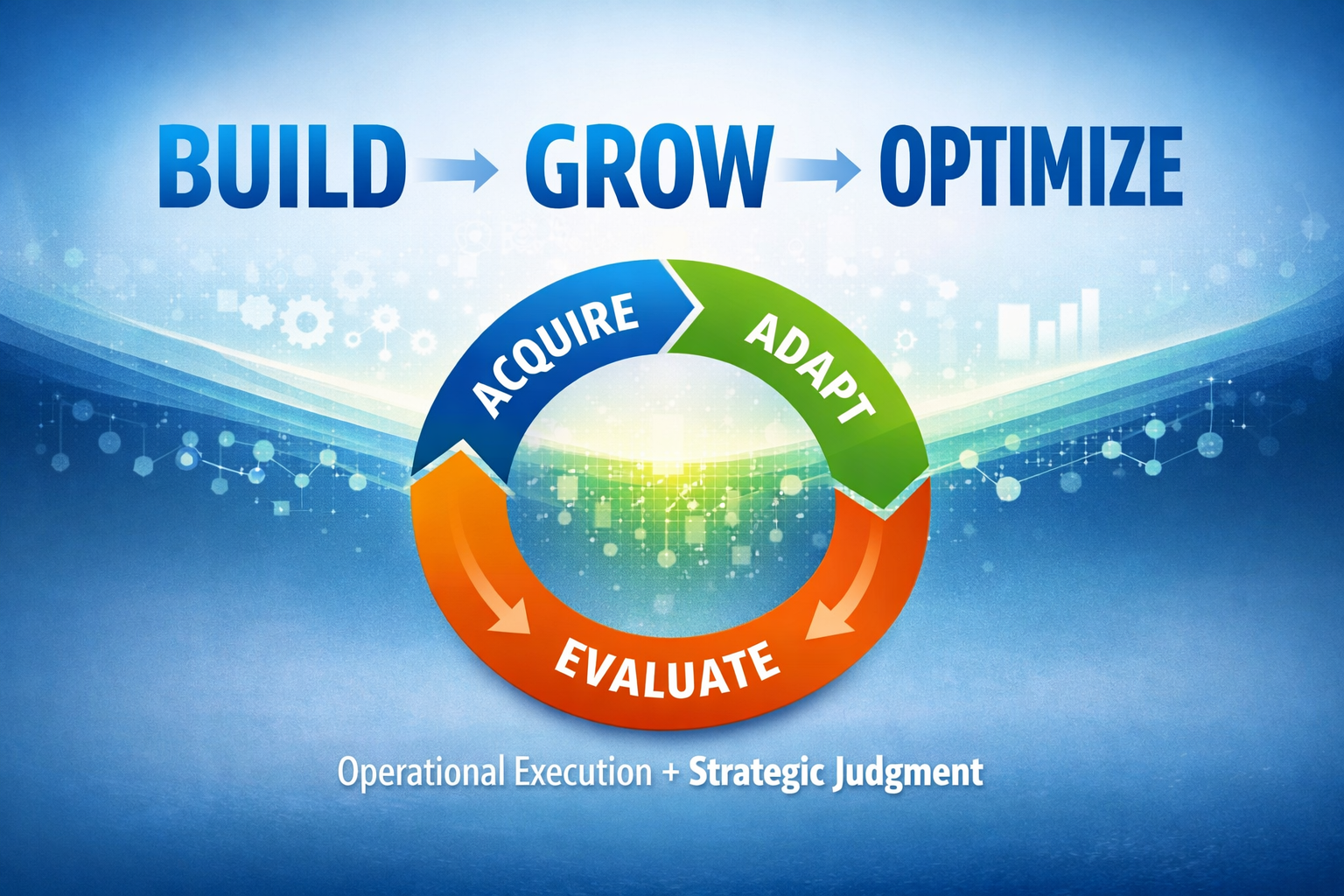
Why Build, Grow, Optimize Only Works When Judgment Improves
Most organizations added AI to marketing and sales this year. And most of them got exactly what the tools promised: more output.
More content. More outreach. More follow ups. More leads. More dashboards. And if you’re a technical organization, more technical debt.
What they didn’t get was better outcomes.
That failure is often blamed on culture, adoption, training, or execution. Those matter. But the structural issue is simpler:
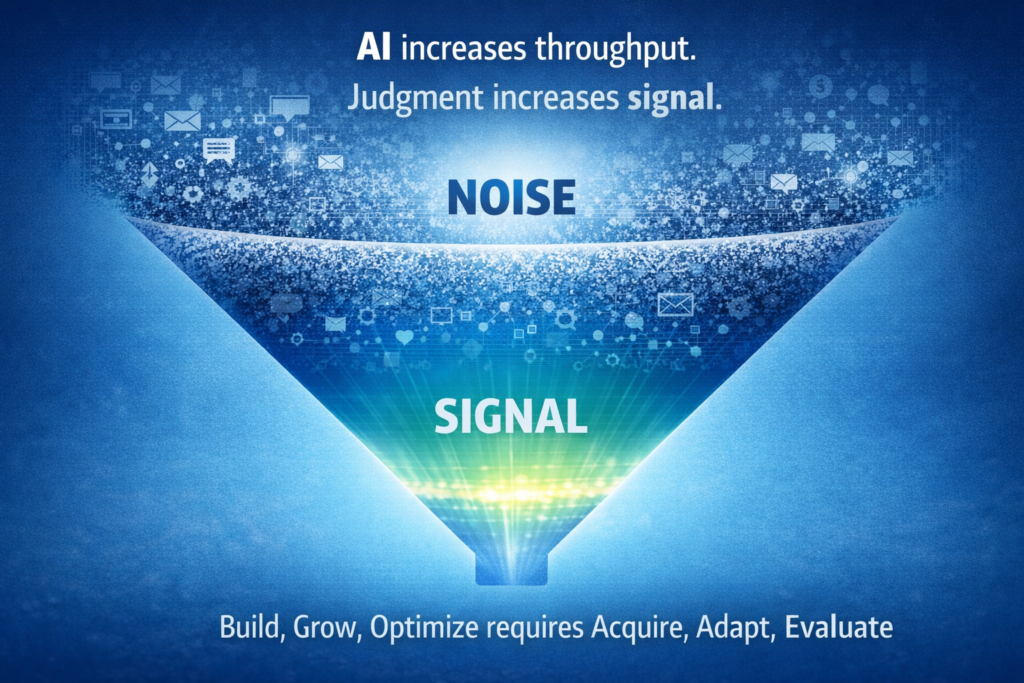
AI increases throughput. It doesn’t automatically strengthen judgment.
If judgment stays the same, AI just helps you push more noise through the same funnel.
And worse, in many organizations, judgment actually degrades. People start to depend on what the AI says instead of using AI to sharpen their thinking. They stop evaluating. They start deferring.
That’s where the funnel breaks.
The problem isn’t AI. The problem is the relationship between AI behavior and human behavior. If the human doesn’t change how they judge signals, AI becomes a noise accelerator.
Signal is the evidence the market gives you that demand is real: intent, pain, urgency, fit, and constraints. Noise is everything that looks like demand but isn’t. Judgment is the human capability to tell the difference and to act correctly on what you find. AI can surface patterns and accelerate analysis, but only humans can strengthen or degrade judgment based on how they use it. This is why Build, Grow, Optimize only works when judgment improves.
Build: Acquire Signal, Not Volume in Your AI Funnel
When companies talk about “building” a funnel, they usually mean building campaigns, sequences, channels, landing pages, and automation. That’s all fine. But that’s not what makes a funnel work.
Funnels don’t fail because you didn’t build enough stuff. They fail because the system can’t reliably acquire meaningful signal from the market.
Signal is intent. Signal is demand. Signal is pain. Signal is urgency. Signal is fit.
Noise is everything else.
AI can help you acquire signal by finding patterns, clustering behavior, and surfacing indicators humans would miss. But AI does not know what you should pursue. It does not know what “fit” means in your world. It doesn’t know which constraints matter most.
Humans judge signal.
That’s the point.
If your team doesn’t strengthen how they judge what AI surfaces, you don’t build signal acquisition. You build a larger noise funnel.
When you deploy AI without strengthening judgment, you get a predictable outcome:
You generate more noise, faster.
AI can absolutely help here. In fact, this is one of the best uses of AI in marketing and sales:
- Detect patterns in inbound behavior that humans won’t see.
- Cluster audiences by shared intent signals.
- Identify which interactions correlate to qualified outcomes, not just engagement.
- Reduce time to insight across performance data.
- Surface early indicators of fit and misfit.
But none of that matters if your people don’t sharpen the judgment that interprets those signals.
If your qualification logic is weak, AI will happily produce “more qualified leads” that aren’t qualified at all. It will simply be better at generating the appearance of demand.
Build starts with acquiring signal, and strengthening the human judgment that determines what that signal actually means.
Grow: Adapt Targeting, Qualification, and Delivery Based on Signal
Growth is where most AI efforts go wrong. Not because the tools don’t work, but because leaders scale what they don’t understand.
If you increase speed and reach before you strengthen judgment, you don’t grow. You inflate.
The same thing happens when teams scale paid campaigns without improving their targeting and qualification. AI just makes it easier to do that at scale.
Real growth is adaptation, not expansion.
Adaptation shows up in five places:
- Criteria
- Targeting
- Content
- Qualification
- Delivery
AI can propose changes. It can suggest segments. It can generate content. It can score leads. It can draft messaging. It can recommend next steps.
But those are suggestions.
The human must judge whether the recommendation fits the reality of the market, the customer, the offer, and the delivery system.
If the human defers, adaptation becomes mimicry. The organization becomes reactive to outputs instead of grounded in judgment. That’s when AI begins shaping the organization, instead of the organization shaping AI.
AI should push you into a different mindset: use the signal to reshape the system, and use AI to pressure test your thinking rather than replace it.
- Adapt your criteria when you learn what misfit looks like.
- Adapt your targeting when you see which segments convert and stay.
- Adapt your content when you learn which messages attract the right buyers.
- Adapt your qualification when you learn what signals predict success.
- Adapt your delivery when you learn what actually drives outcomes.
This is where judgment becomes operational.
And it’s where AI becomes leverage instead of noise.
Optimize: Evaluate Outcomes to Strengthen Judgment
“Optimize” is a tricky word. It assumes the system is stable. It assumes the objective function is known. It assumes you already know what “good” looks like.
Sometimes that’s true. Most of the time it isn’t.
In dynamic markets, the real work is evaluation.
Evaluation is where judgment gets tested.
It’s also where most organizations fail to close the loop.
They measure activity. They measure conversion. They measure pipeline.
But they don’t measure whether their people’s judgment is improving.
And this is where the human-AI relationship becomes the core issue. If teams aren’t evaluating AI outputs, questioning them, and learning from mistakes, they become dependent. Judgment degrades. Weak signals get reinforced.
Evaluation is asking the uncomfortable questions:
- Did we interpret the signal correctly?
- Did we pursue the right customers?
- Did we disqualify the right prospects?
- Did this segment actually fit?
- Did our delivery produce the outcomes we sold?
- What should we stop doing?
- What did we misread?
- What did we over value?
- What did we ignore?
The strongest teams don’t just evaluate outcomes. They evaluate the quality of human judgment that produced the outcomes, including how AI influenced that judgment.
That’s the difference between “AI adoption” and “AI transformation.”
The Judgment Loop: Acquire, Adapt, Evaluate, Acquire
The funnel is not the real model.
The real model is a feedback loop.
Acquire → Adapt → Evaluate → Acquire
Acquire signal from the environment, not volume.
Adapt the system based on that signal.
Evaluate whether your interpretation and adaptation improved outcomes.
Then acquire again, with stronger judgment and sharper signal detection.
This is how Build, Grow, Optimize works in practice.
Not as a linear path.
As a learning system.
And the core of that learning system is the human becoming better at judgment, using AI as a tool to sharpen thought, not as a replacement for thought.
Why This Spans Marketing, Sales, and Delivery Systems
A funnel only looks like a marketing and sales construct when you treat delivery as “downstream.”
In reality, delivery is upstream.
Marketing is where signal is detected.
Sales is where signal is tested.
Delivery is where signal is validated.
If delivery is disconnected from marketing and sales, the loop breaks. Judgment doesn’t improve. The funnel doesn’t learn. And AI becomes an activity accelerator instead of an outcome amplifier.
This is why AI doesn’t fix funnels by itself.
Funnel performance improves when the organization learns faster than the market changes.
That learning comes from closing the loop all the way through delivery and outcomes, and strengthening the judgment that interprets those outcomes.
Practical Takeaways for AI in Marketing and Sales
If you’re investing in AI for marketing and sales, the objective isn’t to “automate” your funnel. The objective is to strengthen judgment.
A few principles hold across nearly every organization:
- Use AI to increase signal clarity, not activity volume.
- Strengthen qualification judgment before you scale outreach.
- Treat churn and retention as a feedback signal, not a customer success problem.
- Measure quality of outcomes, not just speed of execution.
- Make disqualification accuracy a first class metric.
- Close the loop from delivery back into targeting, messaging, and qualification.
- Train your team to challenge AI outputs, not defer to them.
- AI outputs are hypotheses, not answers.
AI should reduce misfit customers and increase predictability.
If it doesn’t do that, it’s not transformation. It’s acceleration.
FAQ
Why doesn’t AI automatically improve lead quality?
Because AI increases output, not judgment. If your criteria and interpretation don’t improve, AI scales noise and misfit leads faster.
How does AI degrade judgment in teams?
Judgment degrades when people defer to AI outputs instead of using AI to challenge assumptions, pressure-test decisions, and verify signals against reality.
What does “signal vs noise” mean in a sales funnel?
Signal is evidence of real demand: intent, pain, urgency, fit, and constraints. Noise is activity and engagement that looks promising but doesn’t convert or retain.
How do you apply Acquire → Adapt → Evaluate to Build, Grow, Optimize?
Build by acquiring better signal, Grow by adapting targeting and qualification based on what you learn, and Optimize by evaluating outcomes to strengthen judgment for the next cycle.
What metrics show judgment is improving?
Rising MQL-to-SQL conversion, higher close rates on fewer opportunities, improved retention, fewer misfit deals, faster time-to-value, and better forecast accuracy.
Closing
AI makes organizations faster.
Judgment makes them better.
Build, Grow, Optimize only works when the system strengthens how it acquires signal, adapts to reality, and evaluates outcomes honestly.
And that requires a deliberate shift in human behavior: using AI to sharpen judgment, not replace it.
That’s where AI creates real advantage.